

-
Roberts, H., Abudayyeh, H., Li, X., Li, X.
June 16, 2025. https://pubs.acs.org/doi/full/10.1021/acsnano.5c00802
Spin defects in solid-state materials offer a platform for quantum sensing that combines the properties of atom-like systems with the scalability, versatility, and technological maturity of semiconductor devices. The past decade has seen increasing interest in host materials beyond diamond which can offer additional functionality and more effectively leverage the advantage of the existing semiconductor ecosystem. This review provides a survey and comparison of spin defects in silicon carbide, hexagonal boron nitride, and gallium nitride with an emphasis on their applications to magnetometry, electrometry, thermometry, and strain sensing. A practical overview of quantum sensing protocols and sensitivity enhancement is provided along with a final discussion of the future direction of the field and remaining challenges.
-
Kim, D.S., Xiao, C., Dominguez, R.C., Liu, Z., et al.
May 9, 2025. https://www.science.org/doi/full/10.1126/sciadv.adt7789
Semiconductor moiré superlattices, characterized by their periodic spatial light emission, unveil a new paradigm of engineered photonic materials. Here, we show that ferroelectric moiré domains formed in a twisted hexagonal boron nitride (t-hBN) substrate can modulate light emission from an adjacent semiconductor MoSe2 monolayer. The electrostatic potential at the surface of the t-hBN substrate provides a simple way to confine excitons in the MoSe2 monolayer. The excitons confined within the domains and at the domain walls are spectrally separated because of a pronounced Stark shift. Moreover, the patterned light emission can be dynamically controlled by electrically gating the ferroelectric domains, introducing a functionality beyond other semiconductor moiré superlattices. Our findings chart an exciting pathway for integrating nanometer-scale moiré ferroelectric domains with various optically active functional layers, paving the way for advanced nanophotonics and metasurfaces.
-
Ni, Y., Huang, D., Liang, D., Liu, A., et al.
Janurary 24, 2025. https://journals.aps.org/prl/abstract/10.1103/PhysRevLett.134.036901
In doped transition metal dichalcogenides, optically created excitons (bound electron-hole pairs) can strongly interact with a Fermi sea of electrons to form Fermi polaron quasiparticles. When there are two distinct Fermi seas, as is the case in WSe2, there are two flavors of lowest-energy (attractive) polarons—singlet and triplet—where the exciton is coupled to the Fermi sea in the same or opposite valley, respectively. Using two-dimensional coherent electronic spectroscopy, we analyze how their quantum decoherence evolves with doping density and determine the condition under which stable Fermi polarons form. Because of the large oscillator strength associated with these resonances, intrinsic quantum dynamics of polarons as well as valley coherence between coupled singlet- and triplet polarons occur on subpicosecond timescales. Surprisingly, we find that a dark-to-bright state conversion process leads to a particularly long-lived singlet polaron valley polarization, persisting up to 200–800 ps. Valley coherence between the singlet- and triplet polaron is correlated with their energy fluctuations. Our finding provides valuable guidance for the electrical and optical control of spin and valley indexes in atomically thin semiconductors.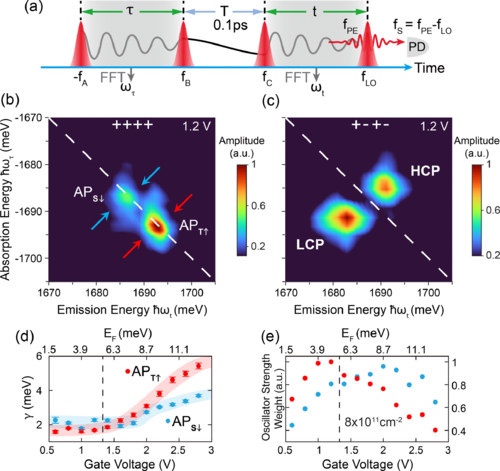
-
Liu, Z., Gao, Q., Li, Y., Liu, X., et al.
August 5, 2024. https://arxiv.org/abs/2408.02176
We identified a tunable interlayer coupling in a van der Waals quasicrystal.
The system shows evidence of hybrid exciton formation and charge localization, both of which are attributed to the strong quasi-crystalline potential.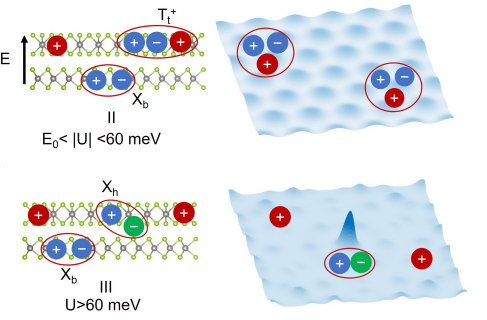
-
Liu, Z., Wang, H., Liu, R., Gao, F., et al.
July 24, 2024. https://arxiv.org/abs/2407.17025
We discovered a new type of trion in a twisted MoSe₂ homobilayer, in which the carrier and exciton are spatially separated.
TEM and Raman analyses indicate that lattice reconstruction is crucial, with the novel trion configuration emerging only in a superlattice that exhibits gradual atomic variations.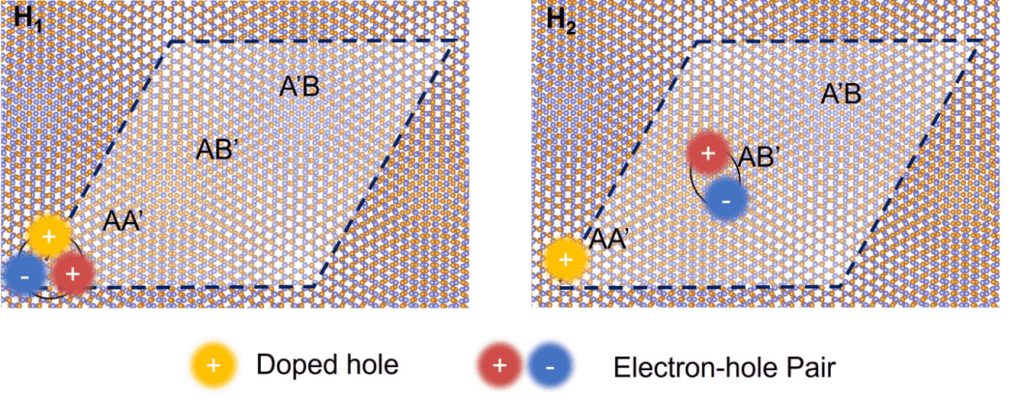
-
Kim, D.S., Dominguez, R.C., Mayorga-Luna, R., Ye, D., et al.
May 18, 2024. https://arxiv.org/abs/2405.11159
– Excitons in atomically thin semiconductors are confined by an in-plane potential well created by a remote moire potential
– Electrostatic moire potential provides a new platform to modulate light properties in spatial and spectral domains
– Confined excitons exhibit hysteresis behavior influenced by t-hBN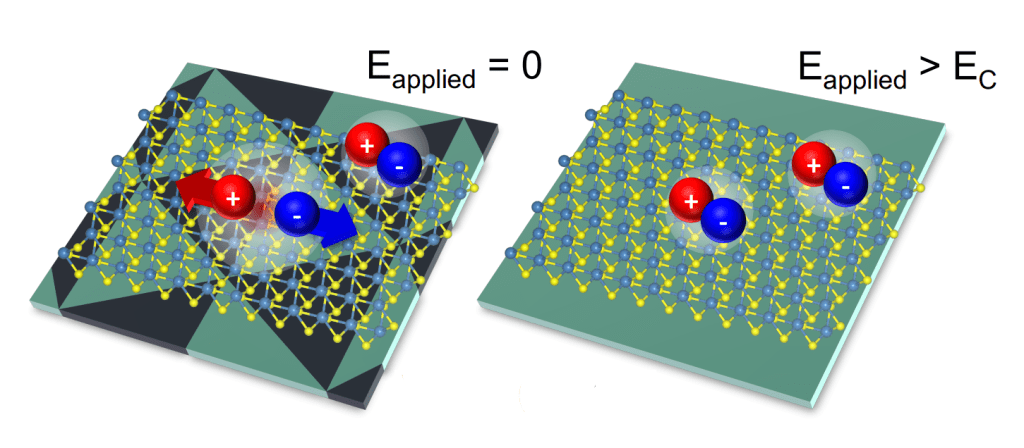
-
Kim, D.S., Dominguez, R.C., Mayorga-Luna, R., Ye, D., et al.
August 10, 2023. https://www.nature.com/articles/s41563-023-01637-7
– Remotely imposed moire potential modulates electronic properties without affecting lattice properties
– Electrostatic moire potential from t-hBN is highly tunable through various factors
– Interplay of moire potentials from multiple twisted layered systems opens up new possibilities for moire engineering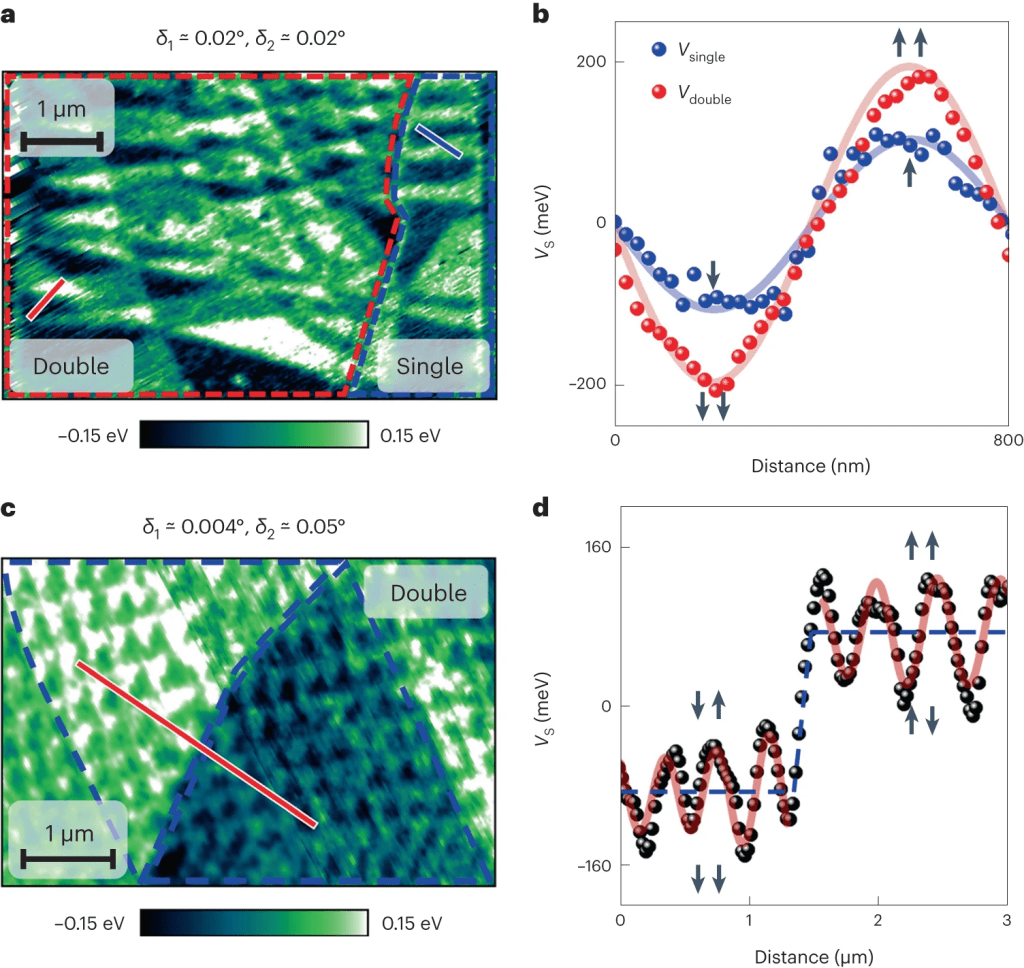
About
Here you can find group publications posted in reverse chronological order.
This only includes some publications submitted past 2023. For a more complete list or for older publications, you can find them at https://scholar.google.com/citations?user=tXabIKoAAAAJ&hl=en
 linanolight.org